Do Urban Bicycle Networks Get More People Cycling?

tumblr_lt04cg0BIX1qenve3o1_1280

This post is also available in: Chinese (Traditional)

The potential benefits of developing urban bicycle networks have been much discussed (including these few suggestions by myself), but for an urban bicycle network to truly achieve its potential and introduce real change to the communities it serves, it needs to get more people cycling, more often. Local economic benefits could be felt if those who already cycle change their habits as a result of bicycle network additions, however bigger changes are likely with more people on bicycles. Similarly, the environmental benefits possible from bicycle networks are mainly to do with creating a switch from automobile-based travel to bicycle travel. A bicycle network can increase access even if it doesn’t increase cycling, but again, a larger group of people having increased access is both more equitable and more beneficial in developing sustainable communities.

It shouldn’t come as a surprise to find out that opinions differ on whether bicycle networks actually get more people cycling. For every researcher or theorist that talks about ‘realising the potential of the bicycle’ through infrastructure developments (thanks for the positivity, Lester R. BrownFeline Gaffron!) there’s just as many calling transformative expectations from urban design ‘unrealistic’ (say it isn’t so, John Hartman, Raymond Pahl!).

But beyond these individual opinions, what does available data tell us? A 2009 study looking at the effect of bicycle infrastructure developments in fifteen different cities, across eight countries and three continents attempted to understand the connection between bicycle networks and bicycle use, with some interesting results.

Looking at almost fifty studies carried out by local governments, national bodies, and independent researchers from outside government, an increase in cycling rates was observed in fourteen of the fifteen cities studied. Davis, California was the only city to observe a reduction in rates of cycling. Despite being the first city in the US to introduce bicycle lanes (way back in the 1960s), Davis has been reducing its commitment to cycling for almost three decades, with cycling rates seemingly running parallel to this. Every other city studied had grown their bicycle networks in recent years, with an increase in cycling rates following. No piece of research is indisputable, but this certainly presents a pretty compelling argument for a positive connection between urban bicycle networks and cycling rates.

Needless to say, the bicycle network debate will rage on even after this blog post. It’s easy to credit changes in behaviour to all kinds of factors, but the connection appears to be pretty clear. Is it a coincidence that after fourteen different cities invested in their bicycle networks they all saw an increase in cycling rates? Is it a coincidence that every European city with high levels of cycling also has an extensive bicycle network?

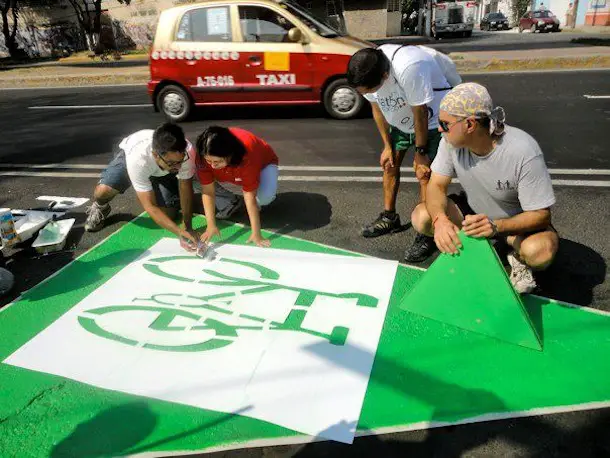
Image courtesy of Kasey Klimes at Secret Republic

  • Anonymous

    Good articles on here

  • http://profiles.google.com/plattypus1 Justin Nelson

    BLARGH! Correlation is NOT causation!

    It is possible that some outside factor- like the cultural cache of bicycles, or an increasing environmental awareness- is driving both increased cycling and increased cycle infrastructure investment. It’s also possible- perhaps even likely- that the causal arrow goes the other way, with additional cyclists driving a demand for more bike infrastructure.

    Just because it’s not a coincidence doesn’t mean it’s precisely the causal story that you want to tell.

    • http://www.thisbigcity.net Joe Peach

      Justin, agreed. As I mentioned, there are numerous other factors that affect behaviour changes (however – I still think that the connection is pretty solid). Whilst this is a single blog post, it forms part of a much bigger story being told on the site over the next 2 weeks, so the cultural issues, and the effect of those factors on cycling levels, will also be explored in more depth. Check them out and let me know what you think!

  • Charles Martin

    I grew up and cycled in a town in the UK with a comprehensive cycle network that was built along with the town from the 1950s up to a decade or so ago. It was great to be able to cycle all around the town with virtually no interaction with road vehicles. However, cycling rates fell as car usage grew, to the point where only 6% of commuter journeys were made by bicycle. Outside of commuting times, the cycle network is now virtually unused. I advocate segregated, comprehensive cycle networks for towns, but they do not automatically get more people cycling. I think the Dutch experience tells us that there also has to be a suppression of the desire to use the car. The UK makes cars; so does the US. The Netherlands do not make cars; the Danes do not make cars. Has anyone studied the possible correlation between these facts and the tendency to prefer cars over bicycles?

  • http://www.flickr.com/photos/7995989@N03/ J

    Clearly, there is more to getting people to ride a bike than mere lanes. It needs to be convenient, comfortable, and common in order to get people to use it. Planners often talk about the 3 E’s: Engineering, Education, and Enforcement. The physical bike network is merely the engineering piece of the puzzle. People need to know how to ride a bike safely, and drivers need to be educated in how to drive near cyclists. Traffic laws need to be enforced so that safety is assured for all users. If a city is too spread out, it is unlikely that cycling will ever be the most convenient means of transportation. However, bike sharing can combine transit and cycling to create multimodal trips that use bicycling for large portions of those trips.