Congestion pricing is gathering some inertia in cities worldwide for a few reasons; safety, money, and public desire are among the main ones. Unlike traditional mechanisms to deal with more cars such as, well, building new roads, congestion pricing has had a profound effect on the cities it has come to. Pricing schemes operate on the same general platform – charge a car if it passes into a certain zone of a city – but each country has generated an architecture that is influenced as much by culture as it is by need. Below is a list of cities (and in one case, a city-state) that have designed and deployed congestion pricing systems:
Singapore

The godfather of congestion pricing systems started with some numbered stickers placed on the windshield of cars. The Area Licensing Scheme (ALS) as it was called was introduced in 1975 and was as simple as you could get. Originally, cars with one or two people in them were charged US$1 every time they crossed a line entering Singapore’s central business district during the peak morning period with carpools of more than three people and trucks exempt from the fee. Violations were costly and vehicle impounding was not uncommon – and in a country with some of the highest auto import duties in the world, financially catastrophic.
The sticker system has thankfully been replaced with a simple transponder-and-toll enforcement and other countries have again followed the tiny city-state’s lead. Singapore has moved in favor of efficiency as it usually does and setup a model for urban congestion pricing—though there was something completely charming about paying your fee with a paper license and trying to avoid the cameras at all costs.
London

Probably the best-known congestion pricing system in the western world. While more technically complex than Singapore’s system the London pricing system has had a similar level of success in reducing traffic for the central business district through an intricate series of cameras throughout the city. The “Ring of Steel” as it is so bellicosely named also plays a double role; the cameras are in place to catch traffic scofflaws as well as more sinister criminals since they are part of London’s expansive closed circuit television system.
The program has become an archetype for other potential systems, especially in the United States, though London’s girded structure differs significantly from the typical grid structure in major American cities. A sort-of Great Wall of Pricing is the concept du mode for today’s transportation economists however, and we have London to thank for that.
San Diego

Southern California isn’t the first place you would think about when discussing progressive transportation policy. Often the only solution for California traffic planners is to pour concrete to deal with the insatiable appetite for new roadways among the perpetually sun-kissed drivers. San Diego has taken that concept, along with its conjoined twin implied demand, and tossed it out the window in favor of a highway-specific congestion-pricing scheme.
The scheme has been tweaked slightly to fit the geographic idiosyncrasies of South California: lots of cars, lots of highways, not a lot of density. It’s not a congestion cordon system like we see in London or Singapore but rather a dichotomous highway tolling system where, if you’re willing to pay, you can zoom by drivers wallowing in the infinite gridlock by using a an express lane that runs parallel to the original highway. These toll-lanes have been called “Lexus Lanes” by activists who see them as just another way that efficiencies favor the rich and the poor will have to deal with high traffic volume until Armageddon (or Carmageddon?), but these toll-lanes were, for better or worse, designed around opportunity costs rather than nominal equality in transportation. People who need to get somewhere fast will pay fast to get there, US$8 be damned, and people who can wait, will wait.
Stockholm

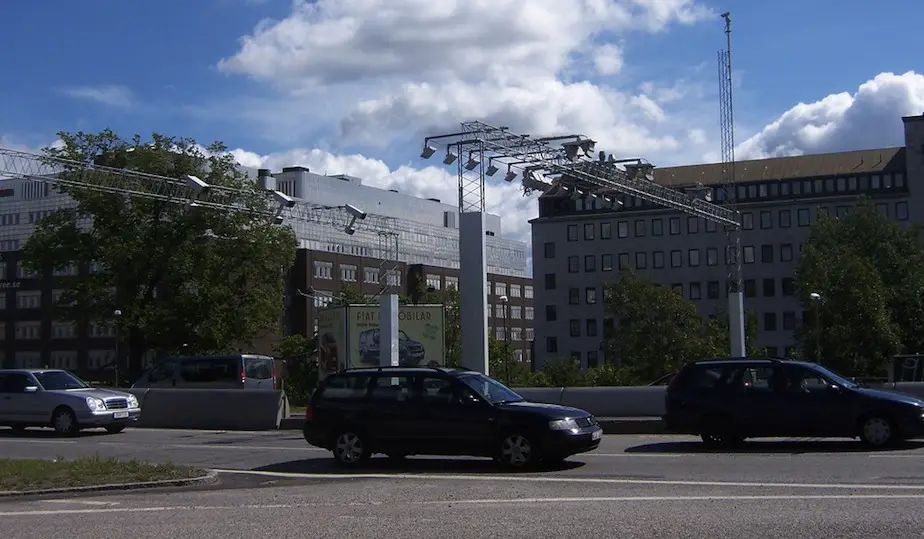
Stockholm, if those slick IBM commercials are indicative of anything, is at the center of the “Smart Cities” movement and they have the congestion pricing scheme to prove. It’s a cordon system similar to London and Singapore where drivers are charged a fee based on their entry into the Stockholm Central Business Distrct. In true Scandinavian fashion they’ve used a light hand for their system and include exemptions for vehicles like motorcycles and foreign-registered vehicles, a smart move that promotes ease of travel for tourists. The congestion charge also disappears during the evenings and very early mornings so revelers and night owls need not worry.
Milan

Improving air quality is an implied goal for all of these congestion pricing systems, by discouraging driving you are encouraging cleaner methods of getting where you are going. Milan has cut out the middle man and made improving air quality the state mission of its system the Ecopass. The scheme, like nearly all the others on this list, is designed to squeeze access to the central business district in Milan and, in an eminently obvious but never before applied way, drivers are charged based on how dirty their cars are. Hummers and Piaggios aren’t going to be charged the same rate to enter downtown Milan because they’re not doing the same damage to the environment—in fact the Piaggio Porter Electric wouldn’t be charged anything to enter the CBD.
The novelty here is in the simplicity of the aims. Milan wants cleaner air, city managers know that cars contribute to it downtown, and traffic engineers can restrict their access by pulling a couple economic levers. It’s quick and dirty –well maybe not dirty—but most importantly it gets the job done and is explicitly geared towards making life better for urban denizens in Milan.
Honorable Mentions: Riga, Latvia; Durham, England; Znojmo, Czech Republic; Valletta, Malta; Miami, Florida (highway pricing); San Francisco, California (not exactly a congestion pricing system, but variable parking fees have discouraged driving and, as advocates point out, finally equalized the nominal and real costs of parking).
And four cities that need congestion pricing:
Delhi – People often come to Los Angeles and shake their head solemnly at the effect that urban sprawl has had on the environment and low-income residents. They have obviously never been to Delhi. It’s a city “on its back” as Paul Theroux once said about Guatemala City, sprawled spread eagle over nearly 600 square miles. Traffic also chokes many parts of the city 24 hours a day and a pricing system that allows for commercial and military exemptions –I include auto-rickshaws under the “military” umbrella, there seems to be an army of them—would go a long way towards organizing one of the more organic cities in the world.

New York – This a little unfair since New York has already designed a congestion pricing system that would restrict access below a given street by adding a more linear version of London’s cordon system. But it got rejected by upstate lawmakers who saw it as a tax on their commuter-based constituency. Not to worry though, NYCDOT Commissioner Janette Sadik-Khan has a way of convincing policy-makers and the public that a progressive transportation edict is one of the best ways to improve health and safety citywide. And if she can’t, she has the blessing of Mayor Bloomberg to use more aggressive tactics in a Robert Moses kind of way.
Bangkok and Säo Paulo– I’m pairing these two cities because I have experience in the former and have never been to the latter but tend to hear that the traffic issues are similar in scope and severity. The sheer road capacity problem in these cities also make them a decent conceptual match; they are not Los Angeles or Shanghai where excess demand can be met, temporarily, with increasing supply on an apparently never ending scale.
This is where congestion pricing gets tricky. If congestion is endemic to a city’s transportation outlook then the potential traffic alleviation can be negated by the volume of cars, unless you take the severe step of charging a toll that only the very affluent can afford which would also make traffic that much worse on incoming arterials where traffic is already choking off access. It’s an issue that no one wants to touch –the very rich bypass the traffic in Säo Paulo by taking a helicopter to the city center—but there’s no doubt that the problem will begin to cripple city economies without a gutsy traffic planning move.
Photos: buzrael, Paul Barter, photosfing, RaymondYu, EURIST e.V., Ambrosiana Pictures