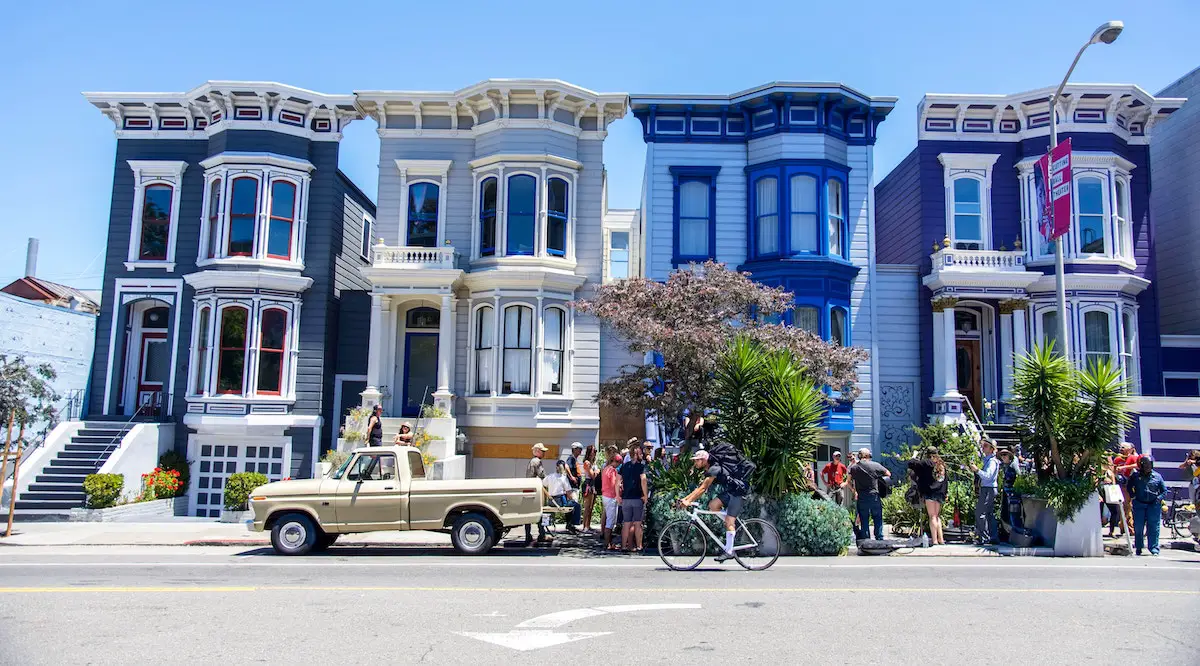
While centuries of urban development in Amsterdam prior to the bicycle’s invention resulted in a city ideal for both bicycle use and a bicycle network, the same cannot be said for London. As a busier centre of trade bound less by geographical restrictions than Amsterdam, sprawl has been a continuous part of London’s urban form.
However, there are some similarities between these cities. Both are relatively flat (or almost completely flat, in Amsterdam’s case) and have a predominantly historic road network. And despite London being a larger city, half of all journeys by car are under two miles. Aspects of London’s recent cultural history are also similar to Amsterdam’s, with car use increasing after the Second World War and bicycle use doing the opposite. However, whilst the Dutch saw this as a cultural change they didn’t want to endorse, the British reacted differently, continuing to embrace automobiles.
One potential reason for these differing reactions could be our collective experience of bicycle use during World War II. Occupying Germans stole thousands of bicycles from the Dutch when they seized the Netherlands, leaving them unable to transport themselves in the manner they were used to. In Britain, however, strict petrol rationing meant bicycle use rose considerably as, for many, it was the only way to get around. The actions of war meant that the Dutch lost their bicycles, but the British were forced on to them.
As soon as the Brits had the opportunity to get off their bicycles they did, with car ownership increasing rapidly in the post-war years, and continuing to remain high. This despite the fact that, as in the Netherlands, campaigns to improve London’s bicycle provisions and encourage a return to bicycle use have been happening since the 1970s.
And whilst Amsterdam pragmatically started transforming itself into a cycle-friendly city, London got a bit distracted. During the 1980s, plans for the London Cycle Network emerged, though construction didn’t begin until 1995 and wasn’t completed until 2010. Viewing the London Cycle Network on a map could lead to a conclusion that the Dutch approach to infrastructure was being replicated. A web of ‘cycle routes’ span central and inner London, supposedly offering direct and attractive routes to destinations. However, whilst the London Cycle Network appears comprehensive in map-form, this is an illusion. Certain sections are segregated and others avoid main roads entirely, but the majority of the network is shared with roads. Features such as on-road marked bike lanes and bike boxes may be present, but much of the London Cycle Network is simply London’s road network, plus a little paint.
Even during the earliest stages of the London Cycle Network, a lack of ambition was obvious, with the preface of the official design manual noting ‘the design of cycle facilities frequently requires a range of compromises to be made’ (and you know you’re in trouble when the notion of ‘compromise’ crops up as early as the preface). These compromises are not only clear in functionality, but in a failure to increase cycling. Ambitious goals to increase the amount of trips taken by bicycle from 1998 levels of 1.36% to 10% in 2012 have not been achieved, or even come close to being achieved. In fact, in the 15 years since construction began, the bicycle share of trips has risen to just 2%. 2012 might be just around the corner, but a 10% modal share for bicycles is not.
The small, mixed-use developments typical of Amsterdam are practical for both bicycle networks and developing sustainable communities. Important amenities are more likely to be within a walkable or cyclable distance, and people are actually on the street, rather than locked up in their cars. But London’s urban form and culture are different to Amsterdam’s, and the challenge of introducing a bicycle network capable of developing sustainable communities is greater. On the most basic level, London’s size means constructing a bicycle network is inevitably going to be a bigger task. However, the economics of the city arguably create a bigger problem than its form. Central London is home to one-third of the city’s jobs, despite only taking up 2% of its land space and housing only 300,000 of its residents. As a result, commuting is standard practice for most Londoners. Even if London was to introduce a bicycle network that prioritsed short distance journeys, it may not be beneficial in encouraging cycling or developing sustainable communities, simply as it isn’t representative of how Londoners move around the city.
London’s more recent bicycle network developments have taken a different approach. Perhaps aware of the failure of the London Cycle Network, 400 additional routes proposed by former-Mayor Ken Livingstone were scrapped under newly-elected Mayor Boris Johnson, with Livingstone’s plans for bike lanes tailored to London’s commuter habits actively supported instead. Twelve direct routes stretching from outer London into the city centre were commissioned in 2008, forming a pattern reminiscent of bicycle spokes. Two of these twelve ‘Cycle Superhighways’, as they have been branded, launched in Summer 2010, with two more opening a year later, and another two planned to open each summer until the completion of the network in 2015. Feedback has been mostly negative:
The superhighway offers in practice no protection against what is a very busy, and in places very narrow and congested, main road. Many junctions are cramped and hazardous, full of revving traffic. Cars often cut across the cycle lane, and are allowed to. – Andrew GIlligan
But despite the overwhelmingly negative response, data collected by Transport for London (TfL) from a one-day manual count suggested cycling levels have increased by 70% along the first two routes compared to one year previous. Whilst a single day count is an unreliable figure, it is at least an acceptable estimate. Cycling levels have clearly risen along the routes, despite the frequent critique of their functionality.
Current efforts with London’s bicycle network show a clear prioritisation of the city’s predominantly non-residential centre. A cycle hire scheme launched alongside the first two ‘Cycle Superhighways’, operates in central London alone, or Zone 1, as the locals call it. Once again, feedback on its functionality has been mostly negative:
It is a very good idea but in practice it is unusable. I used it from nearly day one, but I gave up about three months ago when I had to go to nine different docking stations before I could park my bike, which took over an hour. It’s not a reliable transit system for working people, it’s an amusing curiosity for tourists. – Stephen Bayley
Even Serco – the private firm that runs the service on behalf of TfL – admits there have been problems, saying ‘some aspects of the service still need to be improved’. Yet once again, the numbers suggest the scheme has been a success, seeing over 6 million journeys made by members and casual users just a year after its launch. Its been so popular that capacity is being increased in the city centre, and the scheme will be extended east in the direction of, but not actually reaching, the London Olympics site.
Prioritising ‘zone 1’ is understandable. London’s centre is an economically integral part of Greater London, shaping the culture of city in the process. Efforts to supplement the city’s bicycle network with facilities that cater to the commuting culture and city centre-focus of London, whilst receiving some criticism, have clearly worked, if increasing levels of cycling is the single goal. But what about developing sustainable communities? Cities like Amsterdam and Copenhagen aren’t envied merely because of the amount of people that are on bicycles, the cultural effects are just as important. Whilst still pretty new, London’s recent bicycle network developments appear to be contributing to an increase in levels of cycling in the city, yet their role in developing sustainable communities seems less certain.
Transport for London (TfL) has stated its belief that bicycle networks can ‘strengthen London’s economy by improving access to local town centres’. Whilst numerous studies suggest economic benefits from developing a city’s bicycle network, the flaw in TfL’s logic is that London’s more recent bicycle network developments exist to improve access to the city centre, not the town centres that surround it. The ‘Cycle Superhighways’ are being used as intended, but not in a way that improves access to local town centres, and not in the way that TfL believe bicycle networks can be economically beneficial.
Considering the lack of emissions associated with bicycle use, developing London’s bicycle network could be viewed as an opportunity to improve air quality. Consistently failing to reach the minimum standards set by the EU, London’s air quality is the worst in the UK, and among the worst in Europe. However, the enormity of tackling the city’s poor air quality is beyond the capabilities of its bicycle network. London’s congestion charging system resulted in a 20% drop in car use, the fastest growth rate for the city’s bus system since the 1940s, and a 16% drop in CO2 emissions within the charging zone itself, yet due to the zone’s relatively small size, CO2 emissions across the city as a whole have barely changed. If London’s congestion charge is unable to notably improve air quality as a whole, a truly dramatic increase in cycling would need to occur to see an improvement in air quality. With the Mayor of London aiming for 5% of all trips to be taken by bicycle by the year 2026, the ambition is clearly not present on a government level for such a change.
The design of London’s newest bicycle network additions is also troubling. As with the ‘Cycle Superhighways’, London’s cycle hire scheme prioritises the city centre, launching with all 352 of its cycle hire stations in an area of London that houses only 300,000 of the city’s almost 8 million residents. Those living in that area might get improved access to nearby services, but for the remaining 7.7 million of us, it’s a bit more complicated. Thankfully, the success of the city’s cycle hire scheme means it is expanding eastwards through more residential areas in time for the 2012 Olympics.
In addition to its limited geographical distribution, London’s cycle hire scheme has been criticised for failing to attract a broad range of users. Notably called a ‘posh-boy toy’ by Guardian journalist Tim Lewis, the typical user is young, male, white, and not exactly on the poverty line, if you get my drift. Whilst this problem is indicative of bicycle use in the UK as a whole, it suggests that London’s newest bicycle network addition has failed to make cycling a real alternative for those who wouldn’t already consider that mode of transport. One ‘cycle superhighway’ also presents a worrying example of the city’s priorities. Running from Tower Hill, in central London, to Barking, 9 miles east of central London, the ‘CS3’, as it is known, cuts through Tower Hamlets – ‘London’s most deprived borough’ – providing a speedy route from the city’s central business district to Canary Wharf and beyond. Regarded as London’s second central business district, Canary Wharf is home to numerous international banking headquarters, in stark contrast to the deprivation experienced in other parts of Tower Hamlets. Whilst a bicycle network in this part of London could have been designed to offer affordable transport opportunities that encourage local economic growth and access to services, it was instead tailored to those commuting in between two of the wealthiest parts of London. Sustainable communities was obviously not high up the agenda when the CS3 was developed.
London’s commuting culture dictated the approach taken with its newest bicycle network additions, which has arguably been a success for the city. Levels of cycling are up along the superhighways, and the cycle hire scheme saw 6 million trips made less than a year after its launch. Yet this city-centre focus has made it harder for the city’s bicycle network to introduce benefits on a local scale. Frustratingly, London’s initial attempt at developing its bicycle network had the capability for such change. The London Cycle Network took inspiration from Amsterdam, planning a seemingly comprehensive and web-like infrastructure across the city. Unfortunately, significant delays with its implementation and huge compromises on functionality neutered it. Had London been willing to more fully commit to this initial vision, then a bicycle network conducive to the creation of sustainable communities could have been a reality. Either as a result of a lack of ambition, being too willing to compromise, or something else entirely, this failed to happen, and whilst London’s current approach has brought about an increase in levels of cycling, the benefits on a local scale are less positive.
Photo: Matthew Black