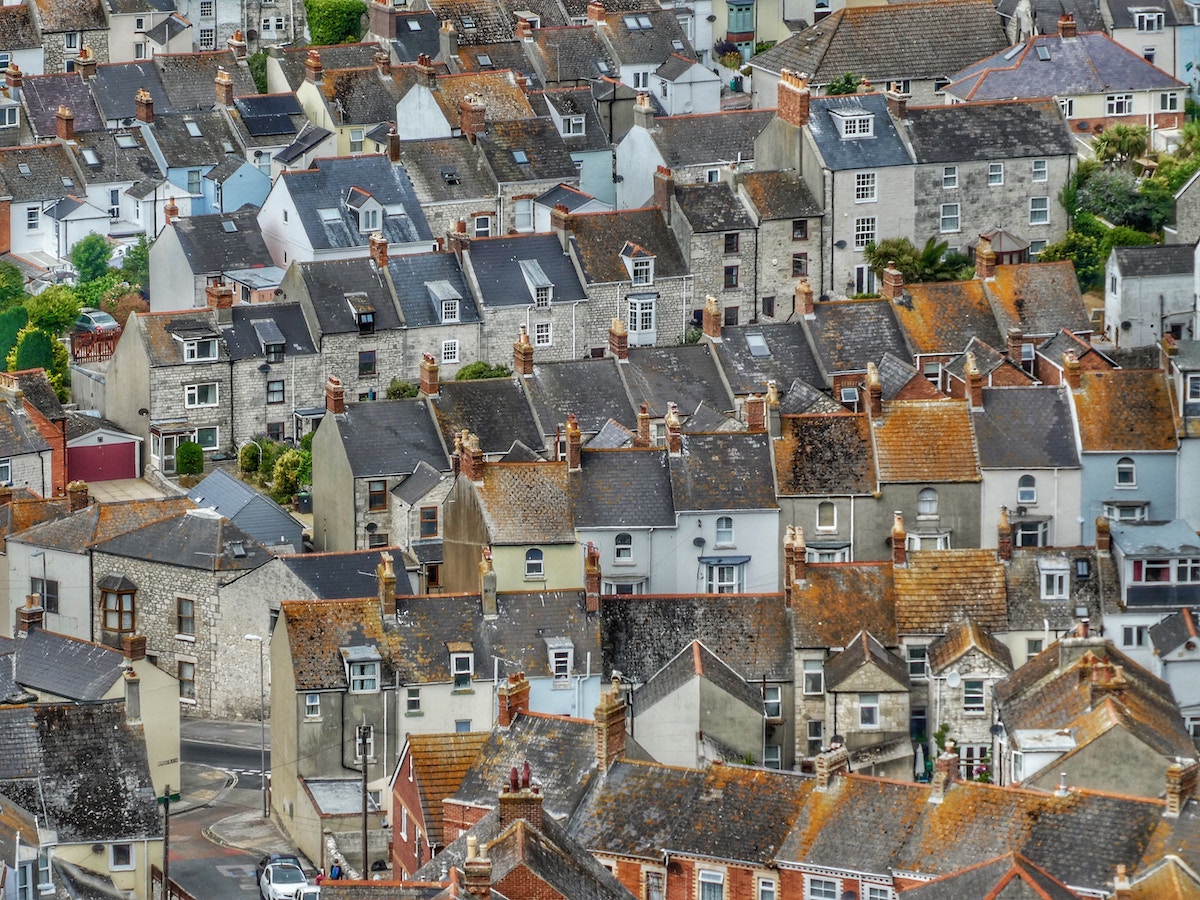
The first home was a single wall, built on an east-west axis. It was dual function, designed to provide a shaded area to its north and a sunny area protected from wind to its south. Over time, additional walls were added along with a roof for protection from rain. Since then, roofs have mostly focused on keeping out rain. Stuck at the top of our buildings and rarely accessed, the roof has been forgotten about, and it’s a missed opportunity.
With up to 80% of heat and energy loss leaving through our roofs, improved insulation should be a priority when attempting to increase the efficiency of our rooftops. A well-insulated loft can reduce the carbon emissions of a home by as much as 935kg a year, equivalent to an annual saving of £110.
Look above street level in any urban area and you’ll spot a loft conversion or two. Even though this change is driven by homeowners looking to increase their square footage, there is potential for real benefit to the environment. With 75% of the worlds population expected to be living in cities by 2050, this maximisation of unused space could play a role in containing urban sprawl.

Green roofing seems like an obvious step when trying to get more from our rooftops. Urban environments often have limited green space, and using our rooftops in this manner has advantages including the provision of habitats for nature that otherwise may not exist. Both the California Academy of Sciences and the Vancouver Convention Centre (above) have green roofs, planted with thousands of indigenous plants. Both have seen a significant increase in the variety and quantity of wildlife visitors.
A rooftop garden also has financial benefits, as a dense green roof is as a highly efficient form of insulation. The United States Postal Service has a 2.5 acre green roof on their New York building, which saves them $30,000 every year on heating and cooling bills. Rooftop gardens absorb carbon, but they don’t become carbon negative immediately, taking about seven years to counteract the carbon emissions involved in its construction.
As close to the sun as they are likely to get, and away from most light-blocking obstructions, rooftops are a great spot for solar panels. Innovation in this area is substantial, driven by competitions like the Solar Decathlon, and the realisation that smart use of solar panels can generate significant amounts of energy for our buildings.
SurPLUShome (below), the winning entry at this year’s Solar Decathlon, is a perfect example of how to maximize energy production from our buildings. The interior design of the building is one continuous space with no closed-off rooms, with 40 silicon solar panels on the rooftop and 250 thin-film copper indium gallium diselenide panels (CIGS) on its sides. It generates 200% of the energy it uses, meaning this building will make you money by selling the surplus energy back to the grid.

However, as most solar panels are placed on top of existing buildings rather than being integrated into them, solar panel theft is becoming increasingly common. The two most obvious solutions for this problem: attach solar panels more securely, or integrate them into the building.
DOW Chemical are pursuing the latter option, with their Solar Shingles expected to be released next year. As the name suggests, these solar panels are shaped like roof shingles and can be built into your average rooftop. They are super thin CIGS panels, as seen on the surPLUShome exterior walls, and are capable of capturing 10% of the light that hits them. Due to their small size and ability to be integrated into a normal roof, the average installation time is 10 hours compared to 22 hours for traditional solar panels, and once installed, they offset 60% of a homes energy consumption.
The financial argument for solar is compelling, which is why we’re seeing companies like Walmart opt for solar energy. They are involved in a partnership with BP solar, who have installed solar arrays on 20 of their stores. These stores generate 30% of their energy from the solar panels, lowering their energy costs and reducing CO2 emissions by 22,500 metric tonnes, or the equivalent of taking 4,000 cars off the road.
In the fight against global warming, one basic but highly effective method often gets ignored – painting rooftops white. This is known as a ‘Cool Roof’, and it reflects the suns rays back into the atmosphere rather than absorbing them.

Ordinary rooftops in New York City have been measured at temperatures over 80 degrees celcius, or 180 fahreneheit, which heats the building and increases the need for air conditioning. In buildings where cool roofing has been employed, the amount of energy used for cooling has dropped significantly, reducing bills by between 20 and 70 percent.
So why aren’t white rooftops a common sight? Perhaps we are resistant to this change because of cultural familiarity with dark roofing. With this in mind, MIT have created the Thermeleon Tile, which is normally black, but turns white when hit by sunlight. It works by placing a common polymer between two plastic layers, with a black one at the back. When cold, the polymer is dissolved and the black back shows through, but when it heats up the solution forms light-scattering droplets which turn the tile white and reflect sunlight. These tiles can reduce cooling bills in the summer by 20%.
The science behind Cool Roofs can apply to more than just roofing. Roads and paving are similarly unreflective, returning only a fifth of the sunlight that hits them. There are hundreds of millions of miles of hard surfaces in the world, with the majority being black. America has 2.5million miles of unreflective hard surfaces, which, if turned white, would reflect 5 trillion watts of sunlight back into the atmosphere ever year. To give that some perspective, NASA estimates that 2 trillion watts of continuous global heating will cause the Greenland ice sheet to melt. Essentially, the impact of turning roads and rooftops white is immense.
So… where’s the paint?
Photos: Gabriel Santiago, Scott Webb, Raoul Croes